
When I first joined SMART, Science Mentoring for Achieving a Richer Tomorrow, I thought I was just signing up for a volunteer opportunity that aligned with my interests in science and service. But I quickly learned that this program wasn’t just about teaching science, it was about opening doors, shifting perspectives, and advocating for dreams that too often go unheard.
SMART originally focused on 8th grade students at the Baylor College of Medicine Academy at Ryan Middle School in Houston’s Third Ward. These students take the STAAR science exam in 8th grade, making them an ideal group to support through curriculum-aligned science lessons and mentorship. But in the 2023–2024 academic year, something unexpected happened, we began to see students from 6th and 7th grade join our sessions too. Despite being younger, they showed genuine excitement for the advanced content and kept returning week after week. It became clear we needed to expand.

The summer before I joined SMART, I worked as a Teaching Fellow at Breakthrough Houston. I mentored students from socioeconomically disadvantaged backgrounds who were brilliant, curious, and driven, yet lacked access to resources. That experience lit a fire in me, a desire not just to teach, but to advocate. I realized mentorship was one of the most powerful forms of advocacy. Sometimes, helping a student believe in themselves is the work.
I started as a SMART mentor in August 2023, and by December 2023, I became the Communications and Mentoring Executive. I loved working closely with both the students and mentors, crafting meaningful learning experiences and building deeper relationships. In April 2024, I stepped up as Project Lead, and exactly one year later, I became the Executive Program Director.
With each leadership step, I carried forward our mission while finding ways to grow. I saw the enthusiasm and potential in those 6th and 7th grade students, so I took the leap to establish tailored SMART programs for each grade level. Now, students can receive three full years of mentorship and science engagement, building confidence, deepening their curiosity, and forming lasting bonds with college mentors.
Our sessions follow a consistent format, the first half is a guided PowerPoint lesson aligned with what they’re learning in class, and the second half is a hands-on science experiment. Every week brings a new topic, a new activity, and new opportunities for growth.
One student story I always carry with me is Alonso. In my first year with SMART, I asked our students what high schools they planned to attend. Alonso quietly said he didn’t even know if he wanted to go to high school. That stayed with me. I made it my mission to connect with him more intentionally. As the weeks passed working with Alonso, I saw changes. He raised his hand, asked questions, worked with others, and even helped his classmates. By spring, he told me he wanted to become an electrical engineer. Later, I found out he was enrolled in high school. That may seem like a small shift, but for me, it captured the heart of what SMART stands for, not just science education, but empowering young minds.

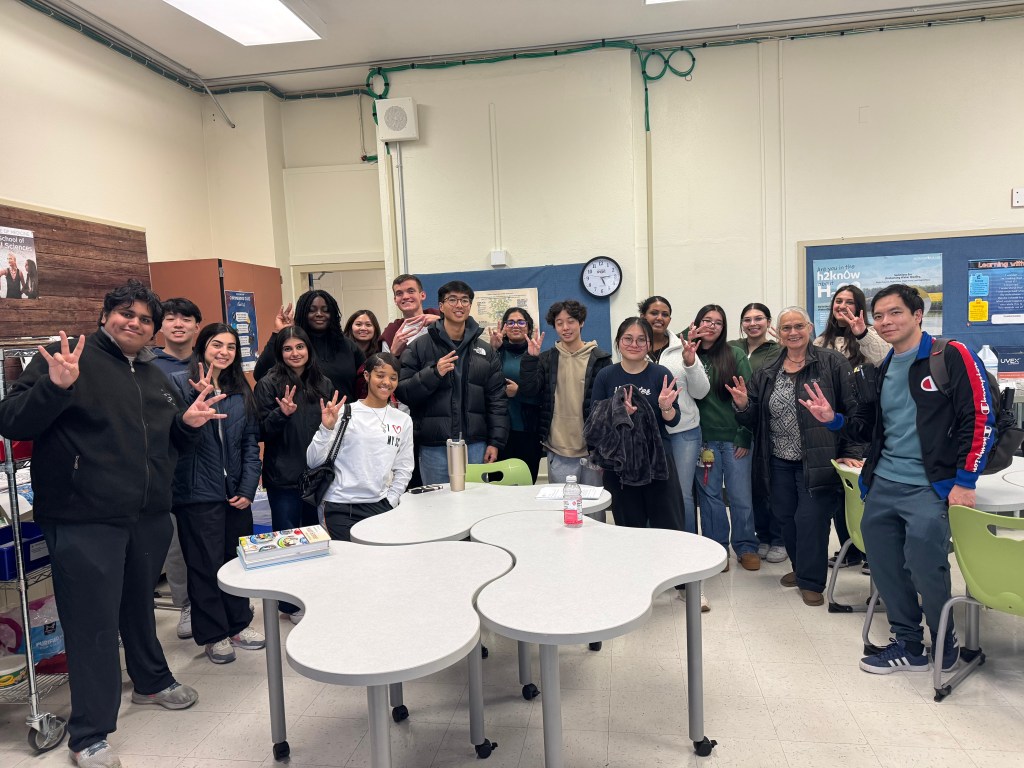
As Project Lead, I partnered with teachHOUSTON to bring in paid undergraduate mentors trained in education. I also collaborated with the Metropolitan Volunteer Program (MVP) at the University of Houston, our largest volunteer organization, to triple our mentor base. We grew from 10 mentors in Fall 2024 to over 30 in Spring 2025, creating a more dynamic and supportive experience for our students.
Each of our mentors brings a unique perspective, different majors, identities, and interests. That diversity lets our students see what’s possible, not just in science, but in life. Whether a mentor studies biology, engineering, or sociology, every interaction shows our students that their dreams are valid, and their voices matter.
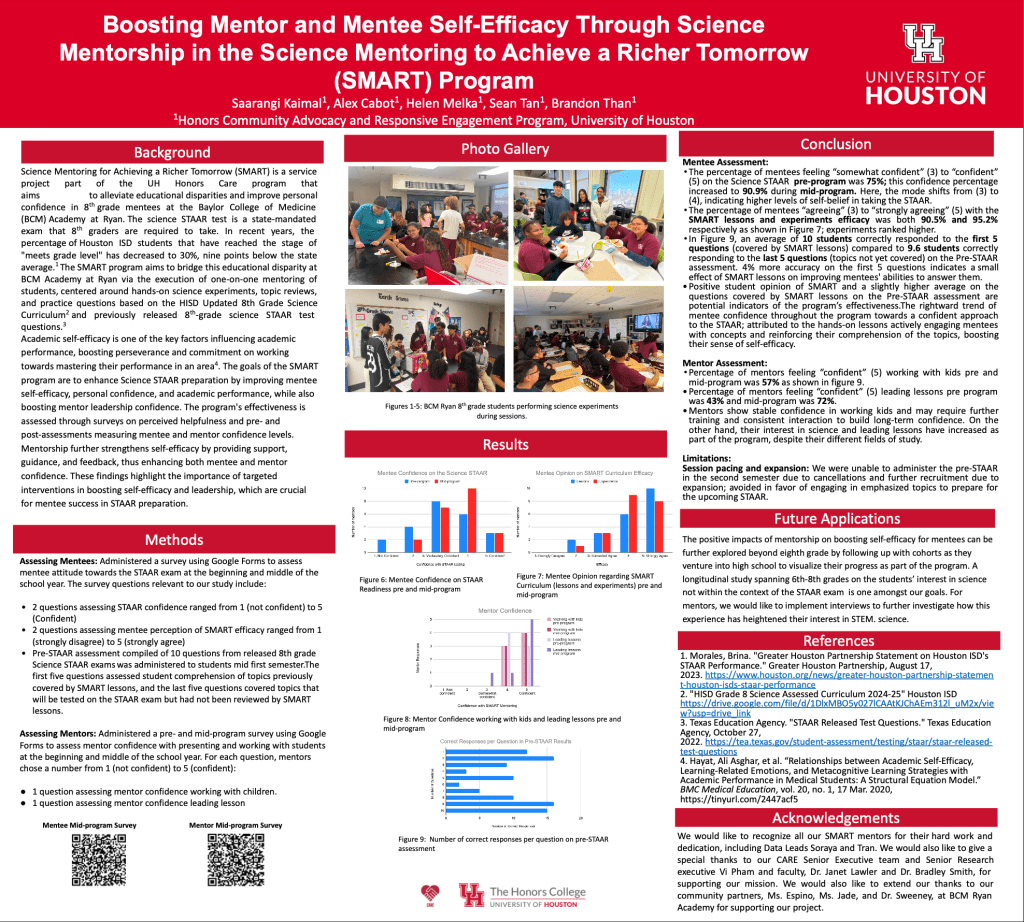
We don’t just teach, we evaluate. In Spring 2025, we presented a research poster titled Boosting Mentor and Mentee Self-Efficacy Through Science Mentorship in the Science Mentoring to Achieve a Richer Tomorrow (SMART) Program at the University of Houston’s 20th Undergraduate Research Day. Through surveys and data analysis, we found that 90.9% of students reported increased confidence in science, and mentors themselves reported higher confidence in teaching and communication. This evidence validates our program’s structure and motivates us to keep improving.
Looking ahead, we plan to organize on-campus field trips for our students, exposing them to research labs, classrooms, and faculty at the University of Houston. We want them to envision a future beyond their neighborhood, a future that feels real and reachable.
Looking back, SMART has become more than a program. It’s a promise, to our students, to our community, and to ourselves, that with the right support, no dream is too distant. Advocacy doesn’t always happen in front of microphones or behind podiums. Sometimes, it looks like a student raising their hand for the first time. Sometimes, it sounds like “I want to be an engineer.”
And sometimes, it begins by showing up, week after week, lesson after lesson, with the belief that every student deserves a richer tomorrow.
A Moment of Reflection
Working with SMART has reshaped how I view service, leadership, and most importantly, advocacy. What started as tutoring has become a personal mission, not just to educate, but to empower. The barriers that prevent students from pursuing their dreams are often systemic, consequently tying to inequities in education, healthcare, and access to resources. My work with SMART has shown me that advocacy isn’t always loud, sometimes it’s quiet, consistent, and deeply meaningful.
As a student pursuing a career in medicine, these lessons are not separate from my future, they are foundational to it. Whether I am in a hospital, a research lab, or a policy setting, I want to carry this same spirit of advocacy forward by advocating for patients, for communities, and for equity in health outcomes. The mission of this blog is to serve as an intersection between medical research, public health equity, and clinical care, and my experience with SMART is one of the clearest examples of how advocacy is the pillar of all three.
Ethical medical practice, like mentorship, is about showing up. It’s about seeing the full humanity of a person; their potential, their fears, their story, even when systems overlook them, and committing to walk alongside them with empathy, integrity, and purpose.

 Benchtop to Bedside
Leave a comment